
Agritainment in Bulgaria: sustainability, culture, and smart fun
21 September 2025
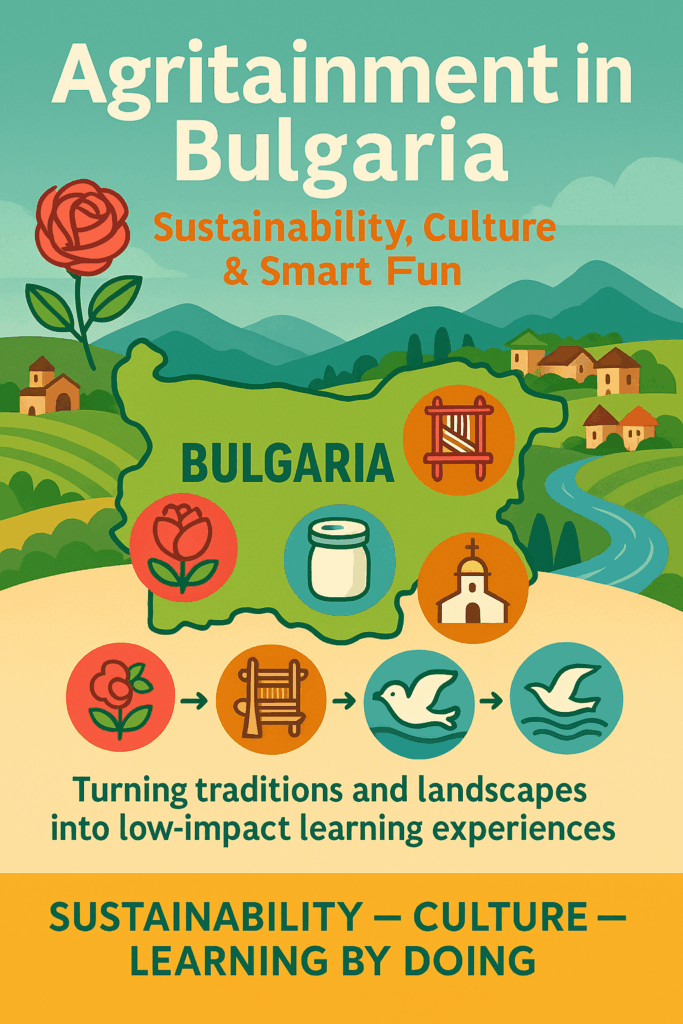
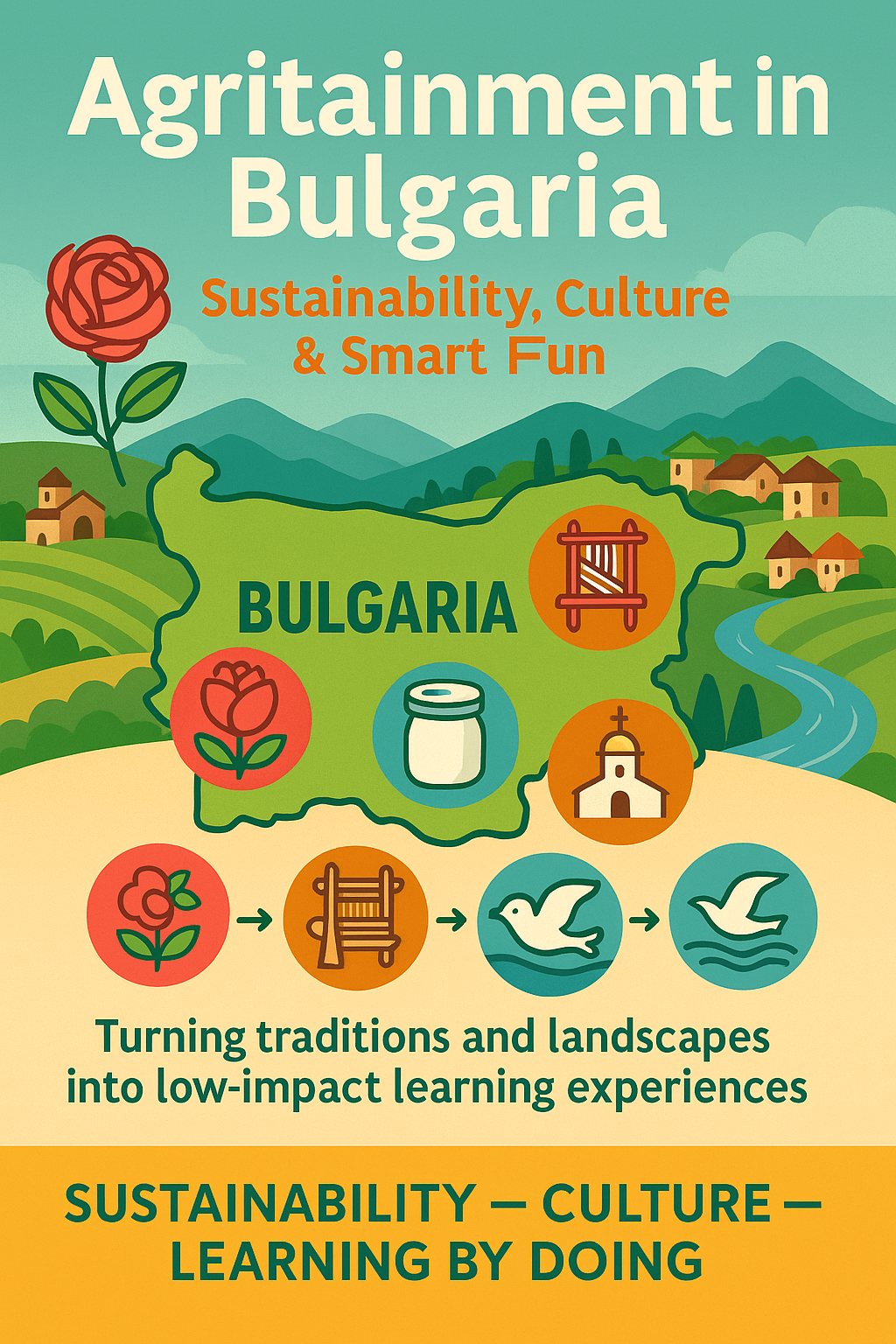
Agritainment in Bulgaria: Sustainability, Culture, and Smart Fun
From Balkan villages to the Rose Valley: turning traditions and landscapes into low‑impact learning experiences
What is Agritainment?
It is the meeting point of agritourism, education, and entertainment: short, memorable, hands‑on experiences that let visitors and students “learn by doing” in farms, heritage villages, and rural landscapes.
Within our Erasmus+ project, Bulgaria is an ideal laboratory: extraordinary biodiversity, vibrant artisanal value chains (from yogurt to rose distillate), and millennia of history visible in monasteries, villages, and archaeological sites. Here, Green Agritainment becomes a practical way to connect environmental and cultural sustainability with new opportunities for local businesses and VET learners.
Why Bulgaria is a Living Lab for Green Agritainment
- Landscapes: mountains, plains, rivers, and coast — diverse settings for seasonal and outdoor activities.
- Living traditions: wood‑ and copperwork, ritual breads, dances and songs, harvest festivals.
- Agri‑food chains: roses and essential oils, yogurt and cheeses, local fruit and vegetables, winemaking.
- Historic heritage: monasteries, 19th‑century villages, Thracian sites that become “open‑air classrooms”.
Sustainability as the Narrative Thread
In Green Agritainment, sustainability is not an add‑on; it is the story that drives the experience: reducing impact, enhancing place, involving the community. Each activity links an ecological practice (e.g., waste prevention, soft mobility, careful water use) to a cultural asset (local memories, recipes, songs, crafts) and to a measurable output (litres of water saved, kilometres walked/cycled, waste avoided). This makes the offer credible for schools and tourism operators and useful for VET learners who learn to design, deliver, and evaluate micro‑experiences.
5 Edutainment Micro‑Itineraries (Replicable Examples)
- Rose Valley — from flower to essence: Short walk among the rows, small‑scale distillation demo, olfactory lab, storytelling on historical trade routes and resilient farming practices.
Output: sensory sheet, “junior perfumer” badge, tips for conscious purchasing (short supply chains, bottle reuse). - Artisan villages — hands, memory, matter: Visit to a workshop (wood, copper, weaving), safe 20–30 minute try‑out, “artisan passport” with stamp.
Output: small creation or prototype, sheet on natural materials and making times. - Dairy farm — yogurt tells the story: Micro‑lab on milk, fermentation, and hygiene; packaging comparison; zero‑waste snack.
Output: circular supply chain poster, measurement of waste avoided. - Monasteries and trails — silence as a resource: Slow itinerary through architecture, icons, and nearby woodland: listening exercises and “travel journal”.
Output: emotional map with rules for responsible visiting. - Wetlands and rivers — life in motion: Intro to birdwatching, photo collection of “water signs” (channels, nests, tracks), game “who lives here?”.
Output: local fauna/flora sheet, calculation of kilometres travelled without engines.
Active Methods for Learning that Sticks
- Learning by doing: every experience includes a safe, useful micro‑action — not just observation.
- Storywalking: walking through stories, objects, and voices; the place speaks and the audience responds with maps and journals.
- Light gamification: passports, stamps, eco‑badges (water saved, steps taken, waste avoided).
- Design for all: inclusive, modular formats with attention to accessibility and language.
- Measurability: simple field indicators that also support project reporting.
Value for Local Communities
Green Agritainment creates value when it generates fair income for artisans and small farms, respects community rhythms and spaces, and leaves practical tools behind (learning sheets, micro‑setups, wayfinding) that remain in place. This is why we work on local partnerships and a stakeholder network (schools, municipalities, businesses, associations) co‑designing formats that are easy to replicate across Bulgaria.
How VET Learners Can Contribute
- Testing and safely leading 30–90 minute activities.
- Producing clear materials (sheets, signage, QR) in two languages.
- Collecting impact data (environment, user experience, local economy).
- Managing communication (stories, ethical photos, captions, UTM tracking).
Call to Action
JOIN US! Become a stakeholder (it takes 1 minute)
If you are an agritourism business, a farm, a VET school, an NGO, a local authority, a guide, or a museum, fill out this form
join the network: you will receive invitations to surveys, focus groups, and pilots.
👉 CLICK HERE FOR THE FORM ONLINE!
If you are a farm, artisan, guide, school, or municipality interested in co‑creating sustainable Agritainment in Bulgaria, join our stakeholder list: you will receive invitations to tests, webinars, and guidelines. Together we can turn knowledge and landscapes into responsible learning and income opportunities.
Leave a Reply